
Paladins of the West Kingdom – A Worker Placement Puzzle That Rewards Mastery
Defend your city, build fortifications, and spread faith across 900 AD West Francia — the heaviest, most satisfying entry in Garphill Games' beloved West Kingdom trilogy.
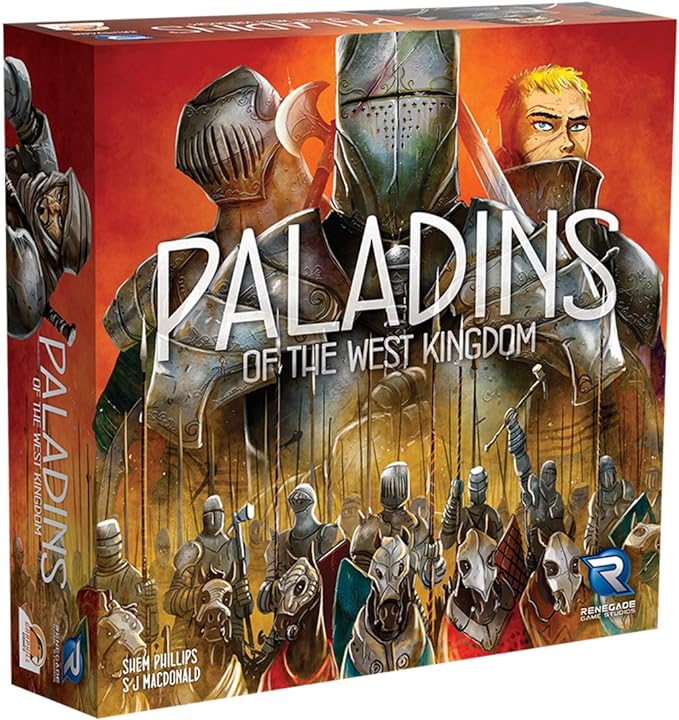

📋 Game Details
Paladins of the West Kingdom is the second entry in Garphill Games' acclaimed West Kingdom trilogy, designed by Shem Phillips and S J MacDonald. Set around 900 AD in a turbulent West Francia, players take on the role of noble men and women defending their city against Saracen scouts, Viking raiders, and darker threats from Byzantium — recruiting the King's finest knights, building fortifications, and spreading faith throughout the land.
At its core, Paladins is a worker placement game with a clever twist. Rather than competing for limited action spaces on a shared board, most worker placement in Paladins happens on each player's own personal board — meaning players can rarely block each other directly. Instead, the tension comes from managing six distinct worker colors, each tied to specific specialized actions, and weaving together deck-building, hand management, and resource conversion into a tightly interlocking engine.
Meeple Mountain's review called Paladins "one of Garphill Games's finest, if not THE finest," while BoardGameShots praised its brilliant mechanics, noting that despite its heavier weight, "the actions are intuitive and follow consistent rules" — a rare combination of depth and clarity that keeps the game accessible even at its most complex.
How to Play — Watch First
What Is Paladins of the West Kingdom?
Paladins of the West Kingdom is a worker placement and deck-building strategy game for 1 to 4 players. Each round, players reveal a Paladin card from their hand of three, granting a unique bonus and determining which colored workers they draw to fuel their actions for that round. Workers in six distinct colors — merchants, clerics, and others — must be matched to the specific action spaces that require them, mostly located on each player's own individual board.
Across the game's structure, players fortify their city, recruit villagers for passive engine-building bonuses, fight or convert outsiders for points, and manage a Suspicion mechanic tied to criminals — accumulate too many Suspicion cards relative to the table's shared tax pool, and an Inquisition forces a costly discard. Three King Orders and five King Favors are gradually revealed across the game, creating shared end-game objectives and limited interactive bonus actions that punctuate an otherwise largely independent, parallel-play experience.
What Makes It Stand Out
Six Worker Colors
Each action requires specific worker types, creating a genuinely satisfying resource-matching puzzle every round.
Paladin Card System
Choosing which of three cards to play, and which to bury in your deck, rewards planning several rounds ahead.
Engine Snowball
Passive villager bonuses compound across seven rounds, making the late game feel dramatically more powerful than the start.
King Orders & Favors
Shared objectives and limited interactive bonuses punctuate the otherwise independent worker placement.
How Does It Play?
A round begins with all players simultaneously revealing a chosen Paladin card, drawing the workers it grants, then taking turns placing those workers (plus any drawn from the shared tavern) onto action spaces — most of which live on their own personal board rather than a contested shared space. This design choice is deliberate: player blocking is rare, since most actions are available only to you. The strategic tension instead comes from efficiently sequencing your own actions and managing which worker colors you'll need turns in advance.
Nerdly's review captured the game's learning curve well, noting that while Paladins "isn't actually hard to learn," it "does come with a lot of complex and far reaching decisions once the game is underway" — first sessions can feel overwhelming simply due to the sheer number of components and options on each player's expansive personal board, but the rulebook is consistently praised as clear, and most groups find the system clicks within a game or two.
One frequently repeated critique, echoed across Zatu Games, Board Game UK, and BoardGameShots: Paladins is a notably low-scoring, low-interaction game. Completing an entire fortification row might earn just nine points, and beyond the shared King Favor actions and tax pool, players largely play their own independent puzzle in parallel — what some reviewers call "multiplayer solitaire." For players who specifically want confrontation, this can disappoint; for players who enjoy a focused, efficiency-driven puzzle, it's precisely the appeal.
Rating Breakdown
Pros & Cons
✅ What We Love
- Deeply satisfying worker-matching puzzle with real depth
- Paladin card system rewards thoughtful, forward-looking planning
- Engine-building bonuses create a genuine sense of snowballing power
- Surprisingly intuitive rules despite the game's overall weight
- Exceptional component quality and consistent Mihajlo Dimitrievski artwork
- High replayability through varied viable strategies
- Strong solo mode for players without a regular group
❌ What Could Be Better
- Minimal direct player interaction — often described as "multiplayer solitaire"
- Low overall scoring can feel underwhelming compared to bigger-number games
- First playthrough setup and rules can feel overwhelming
- Theme feels mechanically thin — abstracted rather than deeply immersive
- A few King Favor card interactions aren't fully clarified in the rulebook
Who Is This Game For?
🎯 Perfect For:
- Fans of heavier worker placement and engine-building games
- Players who enjoy a focused efficiency puzzle over direct conflict
- Groups of 1–3 players, where the personal-board design shines brightest
- Solo players seeking a deep, well-supported single-player experience
- Fans of the West Kingdom series or other Garphill Games titles
❌ Not Ideal For:
- Players who want direct competition and player interaction
- Groups new to heavier euro-style worker placement games
- Anyone seeking high-scoring, dramatic point totals
🛡️ Final Verdict
Paladins of the West Kingdom delivers one of the most satisfying worker placement puzzles in modern board gaming, wrapping six distinct worker types, a clever Paladin card system, and genuine engine-building snowball into a package that's heavier in depth than in rules complexity. Its low player interaction and modest scoring won't suit everyone, but for fans of efficiency-driven euro games willing to embrace a largely independent, parallel-play experience, Paladins is a phenomenal addition to any serious strategy collection.
This helps us keep Blue Dragon Board Games running and ad-free. Thank you for your support!
Leave a Comment on this article:
No comments yet — be the first to share your thoughts!
Leave a Reply